Free local tool · Local engine · Browser dashboard · fob.sh marketing site
Fob
A local base for AI-assisted work.
Fob is a free local continuity layer for AI-assisted work. It runs beside the project on the user's own machine, stores durable project memory, routes prompts to Claude or Codex, synthesizes results into saved decisions, and builds context packets for the next tool or session. The public site at fob.sh explains the product; the actual engine runs locally instead of becoming a hosted dashboard.
- Local app/runtime
- Local CLI
- Local HTTP server
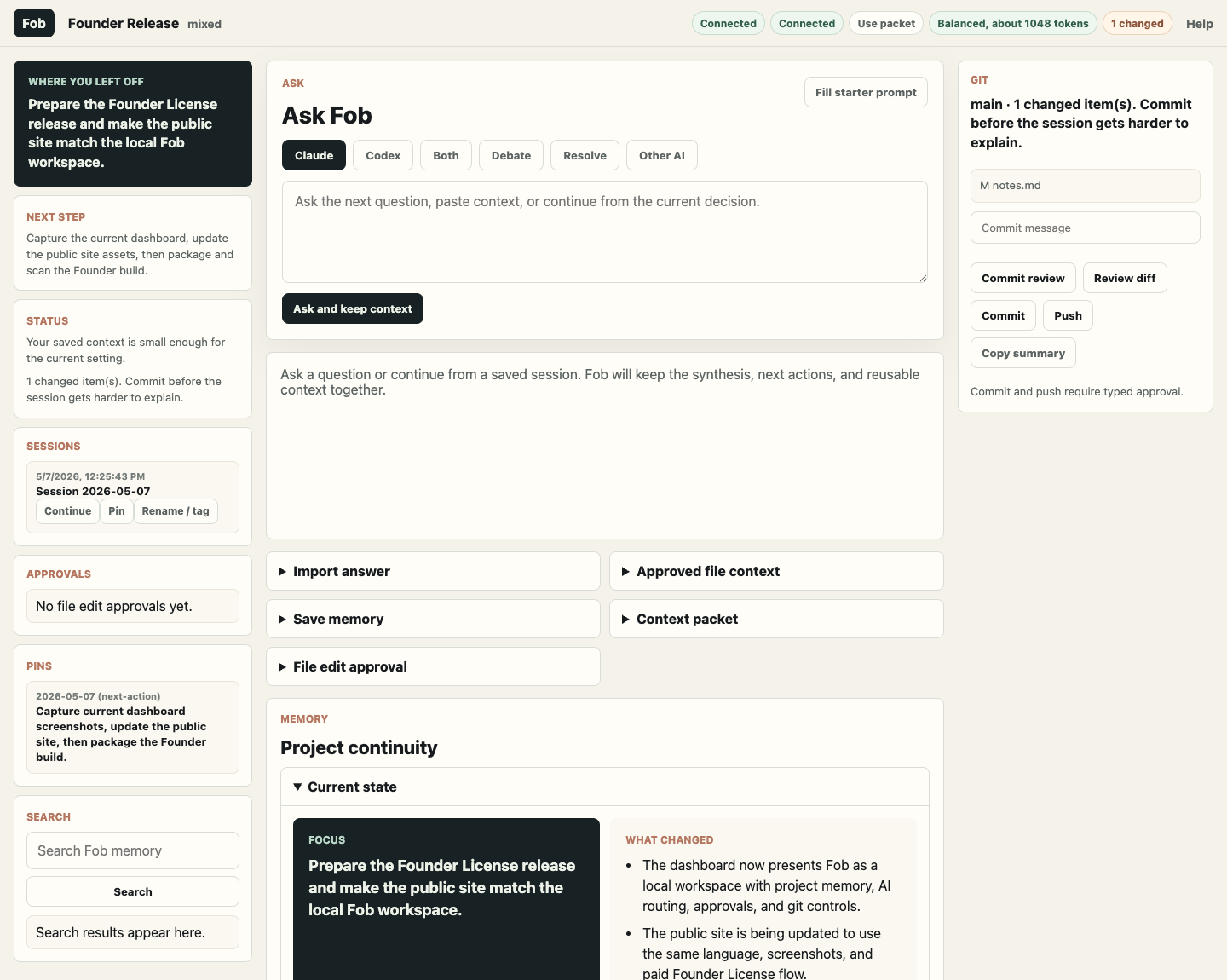
- Browser dashboard
- Claude Code CLI
- Codex CLI
- MCP server
- File-backed memory
- Vercel marketing site
Origin
How it started
Modern builders use more than one AI tool — Claude for planning, Codex for implementation, ChatGPT or Gemini for second opinions — and pay a context tax every time they switch. The pain was not that AI tools could not answer questions; it was that every new session forgot the project. Fob is the answer to that gap: not another chat window, but the memory and decision layer that keeps AI-assisted work continuous across tools and time.
Features
What it does
One terminal room for AI
@claude, @codex, @both, and @debate route work to installed local CLIs from a single project-aware prompt. Claude handles product thinking and critique; Codex handles implementation planning, debugging, and code review; Fob keeps the shared context and turns multi-model noise into a practical next action.
Durable local project memory
/remember, /preference, /decide, /checkpoint, /compact, /handover, /timeline, and /why write durable continuity files into a local memory folder beside the project — so saved decisions, conflicts, and pinned answers survive tool switches, model resets, and future sessions.
Local browser control panel
fob serve opens a private dashboard at 127.0.0.1 with diagnostics, current state, recent decisions, pinned notes, memory, preferences, timeline items, context summaries, search, handoff actions, and browser-based agent routing — all reading and writing local files, no cloud account required.
Context packets for other AI tools
Select relevant saved memory and format a copy-ready packet for ChatGPT, Gemini, Perplexity, Aider, or any other AI without pasting the whole project again. The point is reusing the context you already paid tokens to build.
Git visibility and typed guardrails
Live git state, diff review, file-edit approvals, and typed commit/push confirmations keep risky actions explicit. Fob nudges, warns, and asks — it does not silently push code.
Free local runtime
Fob is designed to run beside the project instead of inside a hosted account. No subscription, no telemetry, no hosted service managing project files.
Under the hood
Engineering
Two surfaces, one product
Fob splits the product into a public Vercel site (fob.sh — explainer, demo, documentation, download) and a local app/daemon that does the real work. That split is intentional: a hosted website should not read a user's local project files or run their local Claude/Codex binaries. The website explains the product; the local engine runs it.
Continuity as a file-backed system
Project state lives in a local memory folder: memory, preferences, decisions, pins, context summaries, current state, timeline, stack, structure, sessions, and runs. The product treats those files as the working memory of the project. Commands do not just answer; they leave a trail future sessions can use.
Routing, synthesis, and saved decisions
The first proof loop was Fob reviewing itself. A @both prompt routed the same question to Claude and Codex with the saved product context, then synthesized the answers into a concrete verdict and naming decision. The important part was not asking two AIs the same thing; it was saved memory changing the quality of the answer.
Headless local API and MCP foundation
The local app exposes API surfaces for dashboard state, status, memory, context, search, saving continuity, and routing prompts. An MCP server foundation lets other agentic tools call into Fob's memory directly — so the same context that powers the dashboard powers anything that speaks MCP.