Python CLI · PyPI cloak-cli · Apache 2.0 · pip install · GitHub public · v0.3.0
CLOAK
Redact code before it reaches an LLM.
CLOAK is a local CLI that redacts code before it reaches an LLM, generates safe-to-paste markdown views of source, and produces test-verified obfuscated copies for sharing — all governed by a .cloakpolicy file checked into the repo. Open source under Apache 2.0, distributed on PyPI as cloak-cli, runs entirely on the developer's machine. The OSS sibling to Fob: same author, same governance philosophy, complementary surfaces.
- Python 3.11+
- Typer CLI
- stdlib ast (Python parsing)
- tree-sitter (JS/TS parsing)
- detect-secrets
- PyYAML
- rich (terminal UI)
- pytest
- PyPI Trusted Publisher (OIDC)
- Apache 2.0
Origin
How it started
The Shadow AI problem is real and observable in every engineering org that has tried to address it. Leadership writes a memo: don't paste proprietary code into ChatGPT. Developers do it anyway because the alternative is missing a deadline. Existing answers are six-figure network DLP bought through IT, or a policy document buried in Confluence. CLOAK is the missing third option — a small CLI that lives in the same workflow developers already use, with authority following merge access on a YAML file in the repo.
Features
What it does
scan
Wraps detect-secrets and layers in custom regex rules from .cloakpolicy. Exits 1 on findings, JSON output for CI, drop-in pre-commit hook. Years of regex/entropy tuning come for free; the proprietary-marker rules are configured per-repo.
diff-context (dry-run)
Runs the same redaction logic as cloak context but writes nothing — just reports per-file counts of function bodies, proprietary tables, and docstrings that would be removed, plus byte reduction. Engineers see what gets redacted before they trust the transformation.
context
Generates a redacted markdown view of the repo. Function bodies hidden, signatures kept, imports preserved, proprietary UPPER_SNAKE tables stripped. Safe to paste into ChatGPT or Claude. --copy to clipboard. --strict aliases enums and strips docstrings for higher-stakes prompts.
obfuscate --verify (the differentiator)
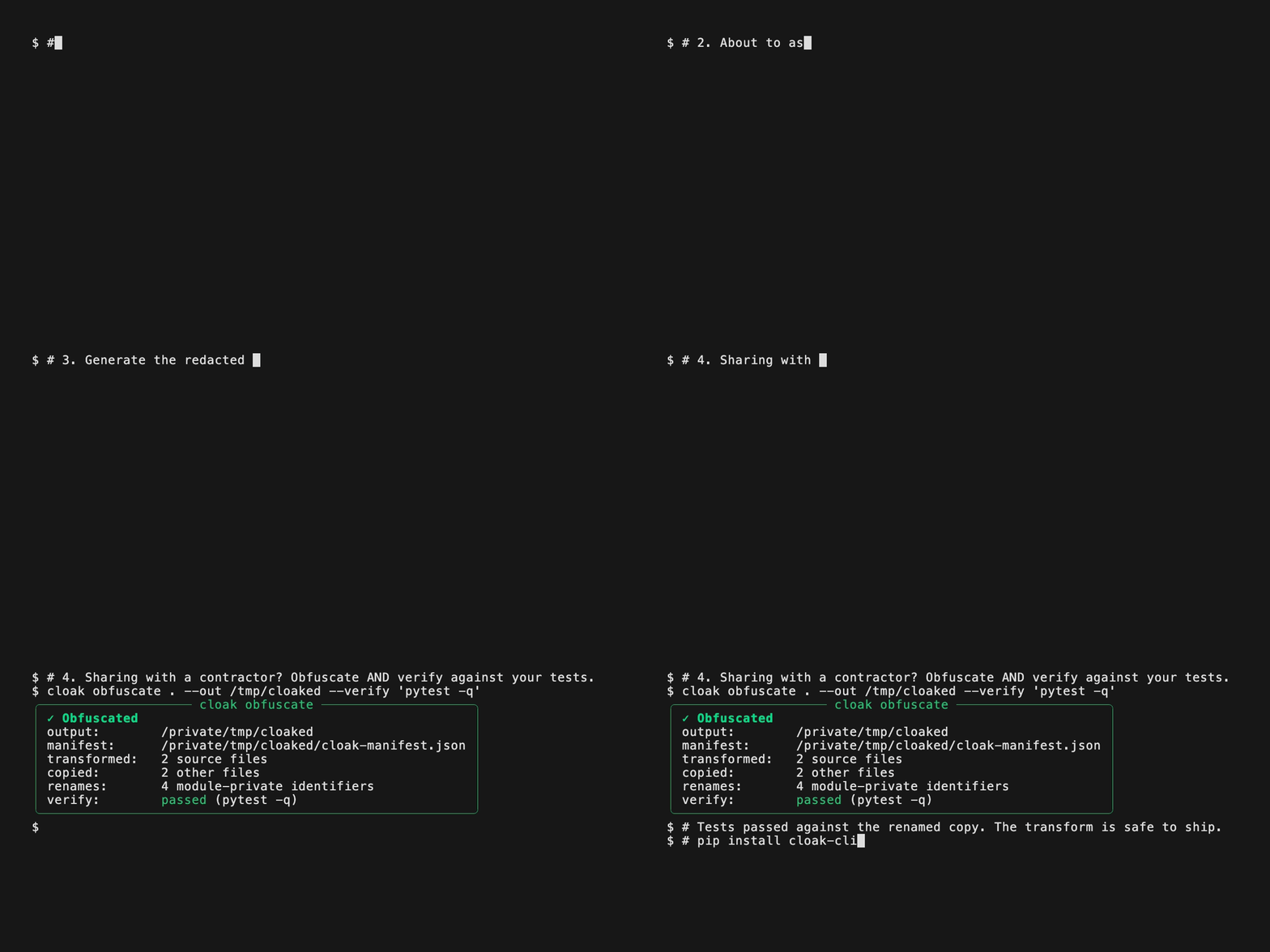
Renames module-private identifiers, optionally strips docstrings per policy, then runs the user's actual test command against the output. Tests fail, the operation fails. That single flag is the line between a redactor and a tool you would hand to a contractor. Ships a manifest with sha256s, the rename map, and the policy snapshot — full audit trail.
.cloakpolicy governance
A YAML file at the repo root, checked into git, reviewed via PR. Authority follows merge access. There is no separate permissions system to invent. cloak policy init scaffolds a sensible starter policy after detecting the project's language and source directories.
Honest positioning, on purpose
The README, the PyPI page, and the marketing site all state explicitly: a motivated reader given an obfuscated copy can still extract logic. CLOAK is governance plus friction tooling — not cryptographic protection. The honest framing is the line that separates CLOAK from the dishonest end of the obfuscation market.
Under the hood
Engineering
Two parsing backends, one CLI
Python redaction uses stdlib ast (no external runtime dependency, ast.unparse for output). JS/TS uses tree-sitter with a byte-splice strategy: parse → collect (start_byte, end_byte, replacement) tuples → apply edits in reverse order so earlier offsets stay valid. The byte-splice approach preserves all formatting and comments outside redacted regions — never reformat the source.
Verified obfuscation as a product invariant
obfuscate --verify subprocess.runs the user's test command against the transformed output, sets verify_passed in the manifest, and exits non-zero on failure. The output ships with cloak-manifest.json: source/output sha256s, the rename map, the policy snapshot, command-line args, and the verify result. Without --verify, 'obfuscation' is a guess. With it, the output is credible enough to hand to a contractor.
Phase 0 validation before code
Before writing any of the parser infrastructure, a structured experiment ran two redacted versions of a fake pricing engine through a live LLM with architectural and adversarial prompts. The data surfaced a leak surface that wasn't obvious from intuition: docstrings carry intent, enum values carry market data. That result forced the two-tier (default + --strict) design. The product is small because the design choices were pre-validated.
OSS-pure distribution, by decision
Apache 2.0, GitHub public from day one, PyPI Trusted Publisher (OIDC, no stored tokens), branch protection on main, CI matrix on Python 3.11/3.12/3.13, ruff + mypy --strict clean, 88 tests passing. The CLI is intentionally free forever: license keys only work when they unlock something server-side you control. Locking down a client-side CLI you can fork in twenty minutes is theater. Any future monetization lives in a hosted/team layer, not the OSS surface.