Live trial · Web · brykk.app/local · Next.js · Supabase · Redis · Web Push
Blue Springs Local
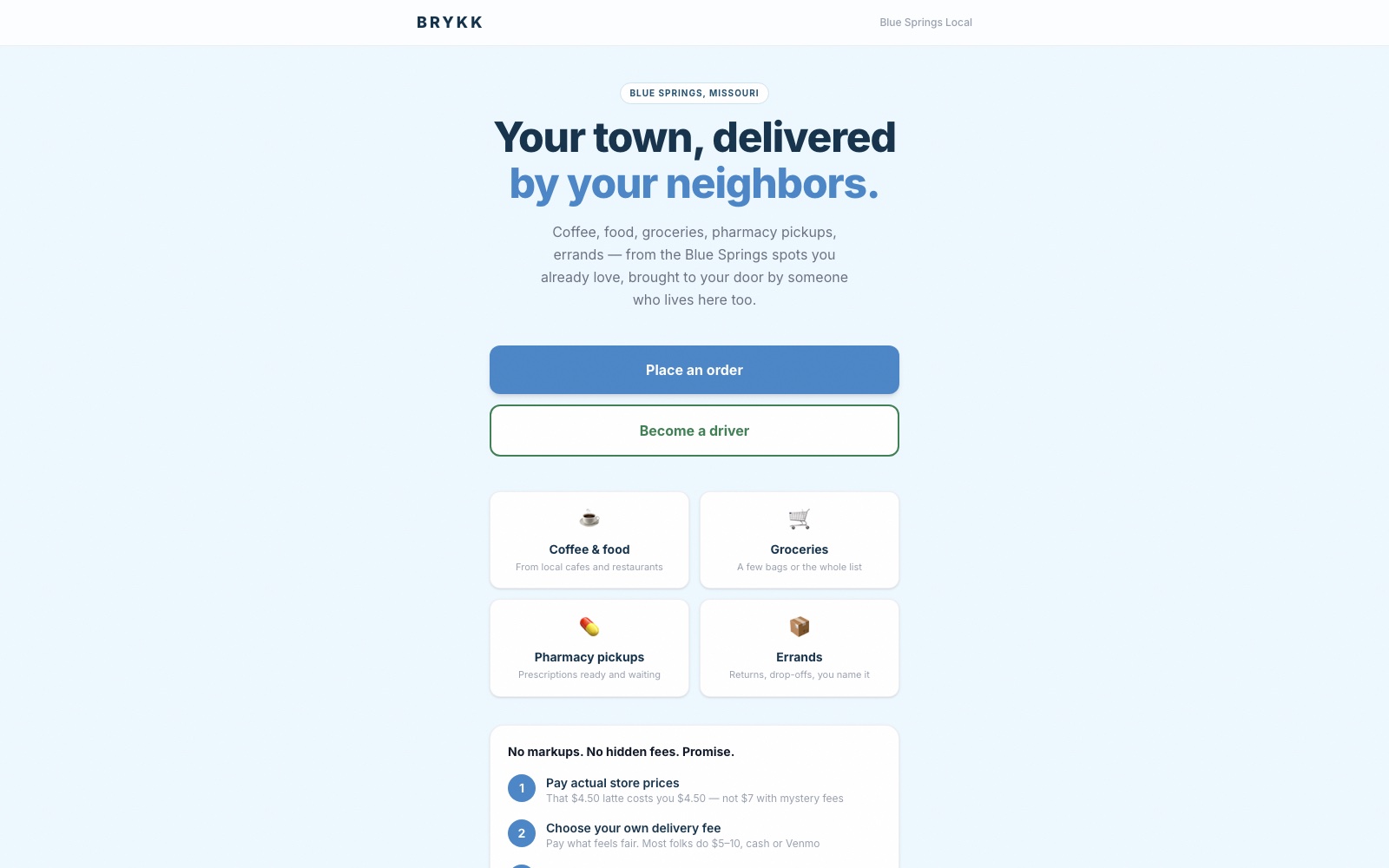
Your town, delivered by your neighbors.
Blue Springs Local is a peer-to-peer delivery network for one real town. A customer places an order in the browser and gets a trackable link — that link is their whole account. Approved local drivers see the order on an open board, claim it first-come-first-served, and publish their location every three seconds while the customer watches the approach on a live map with distance countdown and automatic arrival detection. Store prices stay store prices, the delivery fee is whatever the customer offers, and the driver keeps all of it.
- Next.js 16
- React 19
- TypeScript
- Supabase (Postgres + OTP auth)
- Redis (ephemeral tracking)
- Leaflet
- Web Push (VAPID)
- Tailwind CSS 4
- Vercel
Origin
How it started
DoorDash turns a $4.50 latte into a $7 line item and pays drivers a cut of the scraps — and it doesn't even serve every corner of a town like Blue Springs. BRYKK had already solved the hard part for a different reason: its Meet-Up feature lets two people share live locations in the browser with no app install. Pointing that machinery at delivery — order form in, driver board out, live tracking in between — turned a family-safety codebase into civic infrastructure. The MVP was planned on June 10 and serving the town on June 11.
Features
What it does
Order with a link, not an app
No install, no account, no password. The customer fills out one form — items in plain text, pickup spot via geocode search, dropoff address — and gets an unguessable order code. That link is their authentication, their status page, and their live tracking map. Links are SMS-able on purpose: in a real town, the product spreads by text message.
Live driver tracking with arrival detection
Once a driver picks up the order, the customer's status page becomes a live map: driver pin moving in 3-second updates, pickup and dropoff stops, distance countdown, and ETA. At 30 meters out, the page flips to a 'driver arrived' banner on its own — the same geofence arrival logic BRYKK uses for family safety.
Open driver board, atomic claims
New orders hit every active driver as a web push notification with a chime. The board is first-come-first-served — the claim is atomic, so two drivers tapping at once can't double-book — and each driver carries one active order at a time. Sign-up is email OTP into a pending queue; a human approves every driver before they see their first order.
Drivers keep 100%
There is no commission, no markup, and no payment processor in the middle. The customer offers a fee — most do $5–10 — and settles in cash or Venmo at the door; the driver's payment handle surfaces right on the arrival screen. The trial's entire economic design fits in one sentence: store prices stay store prices, and the person who drove gets everything the customer paid for the drive.
Location privacy by architecture
Live driver coordinates exist only in Redis with a TTL, and get scrubbed the moment the delivery completes. The durable order record keeps timestamps and addresses — never a breadcrumb trail. Privacy-first wasn't bolted on; it was inherited from BRYKK's design rules.
Trial hardening
A 25 km service-area geofence around Blue Springs rejects out-of-town orders, per-IP rate limits blunt prankster floods, dead push endpoints prune themselves, and an operations console handles driver approvals, order reassignment, and the day's stats.
Under the hood
Engineering
BRYKK's relay machinery, re-aimed
The live-tracking stack is BRYKK's Meet-Up feature — browser geolocation polling into Redis sessions with TTL and scrub-on-end, Leaflet maps, Haversine distance, 30-meter arrival geofencing — adapted from 'two people finding each other' to 'one driver, one customer, one order.' Proven infrastructure crossing product domains is the whole story: the family-safety app became the town's logistics layer without a rewrite.
The link is the account
Customers never authenticate. The 8-character order code is unguessable, and possessing the link is possessing the order — status, tracking, and history live behind it. Drivers get the same treatment with a durable access code. For a community trial, eliminating account creation eliminated the single biggest funnel killer; recent orders cache client-side so repeat customers one-tap reorder.
Planned Tuesday, live Wednesday
The architecture pivot doc is dated June 10; the MVP commit — order flow, live tracking, driver board, operations console — landed June 11, followed the same day by driver access codes, payment handles, arrival banners, and trial hardening with geofence and rate limits. Roughly 4,300 lines of TypeScript across 19 files and three Supabase migrations, riding an existing production deployment.
What's possible
A template for every small town
Nothing in the architecture is Blue Springs-specific except one pair of coordinates and a radius. The trial is testing whether a town will run its own delivery network when nobody takes a cut — if it holds, the same stack stamps out for any zip code, and the iOS-grade location engine BRYKK already owns becomes the driver-side power tool.